Kit vs beehiiv: the point where the cheaper one changes
Last updated 2026-09-20. Every number on this page was read from the two official pricing pages in a browser on that date. Prices change — confirm on the official page before you sign up.
The short answer
Most comparisons of these two end with "it depends". Here is the part that actually decides it, and it is arithmetic rather than opinion: at a small list Kit is the cheaper paid plan, at a large list beehiiv is — and the swap happens between 5,000 and 10,000 subscribers.
- Choose Kit if the list is the asset. Its free plan is listed as “Free—up to 10,000 subscribers” with “Unlimited landing pages & forms”, “Unlimited email broadcasts” and “Sell digital products & subscriptions”.[1] Four times beehiiv's free ceiling, and the cheaper paid plan until your list is somewhere past 5,000.
- Choose beehiiv if the newsletter is the product. Its free Launch plan lists “Newsletters, Website, and Podcast” and “Unlimited Email Sends” — a whole publication rather than a mailing tool — and its paid price rises more slowly, so by 10,000 subscribers it is the cheaper of the two.[2]
If you want one sentence: Kit stays free for a much bigger list; beehiiv gets cheaper once you are paying for a big one.
How we checked this (and what we did not check)
What we did. On 2026-09-20 we opened kit.com/pricing and beehiiv.com/pricing in a browser and read the pages themselves. On each page we moved the subscriber control through every step it offers and recorded the price shown at each one, with the billing switch in both positions. Feature wording in quotation marks is copied from those pages word for word.
What we did not do. We have not used either product. There are no screenshots of either tool on this page, no account, no test send, and no opinion about how either one feels to use. We cannot tell you which editor you will prefer, how their deliverability compares, or how their support answers, because we have not measured any of it.
We also recorded every step of both subscriber controls rather than the one price each page happens to open on, because the step you land on is the only one that applies to you. Where a page stopped changing its price at the top of its range, we say so rather than extending the line ourselves.
What that leaves. Two price ladders on the same day, side by side — which is the one comparison neither company publishes, because it involves the other one.
At a glance
| What you need first | Kit | beehiiv | Which fits |
|---|---|---|---|
| The biggest free list | “Free—up to 10,000 subscribers”[1] | Launch: “Up to 2,500 subscribers”[2] | Kit, by four times |
| A website and a podcast without paying | Not listed on the Free plan[1] | “Newsletters, Website, and Podcast” on Launch[2] | beehiiv |
| An automatic welcome sequence | Listed under Creator[1] | “Email Automations” listed under Scale[2] | Neither, while free |
| Lower paid price at 1,000 subscribers | Creator, $33/mo billed yearly[1] | Scale, $43/mo billed yearly[2] | Kit |
| Lower paid price at 10,000 subscribers | Creator, $116/mo billed yearly[1] | Scale, $96/mo billed yearly[2] | beehiiv |
| Removing the platform's branding | “Remove Kit branding” on Creator[1] | “Remove beehiiv Branding” on Max[2] | Kit, one plan earlier |
Where the cheaper one changes
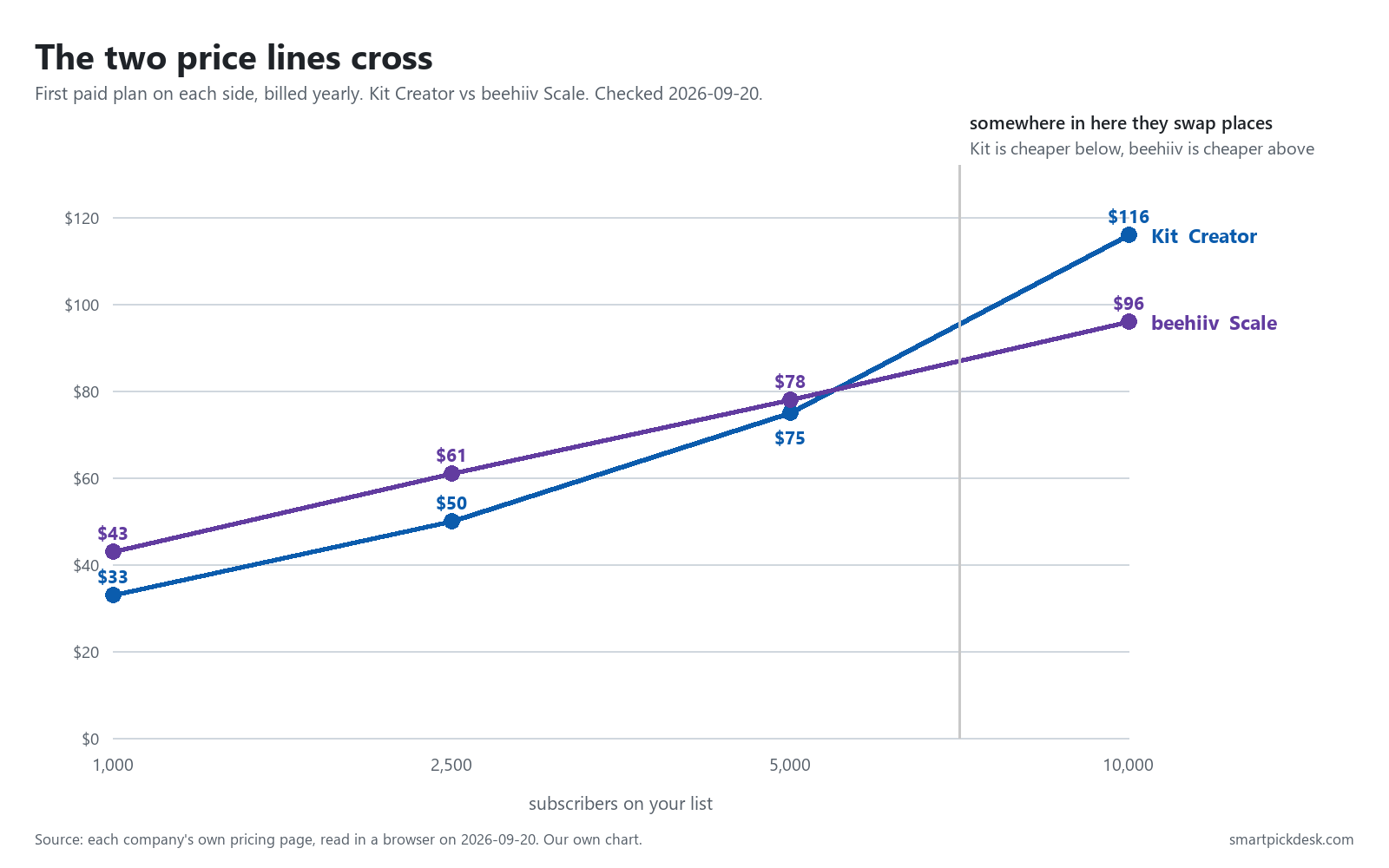
This is the chart neither pricing page can show you, because each one only plots itself.
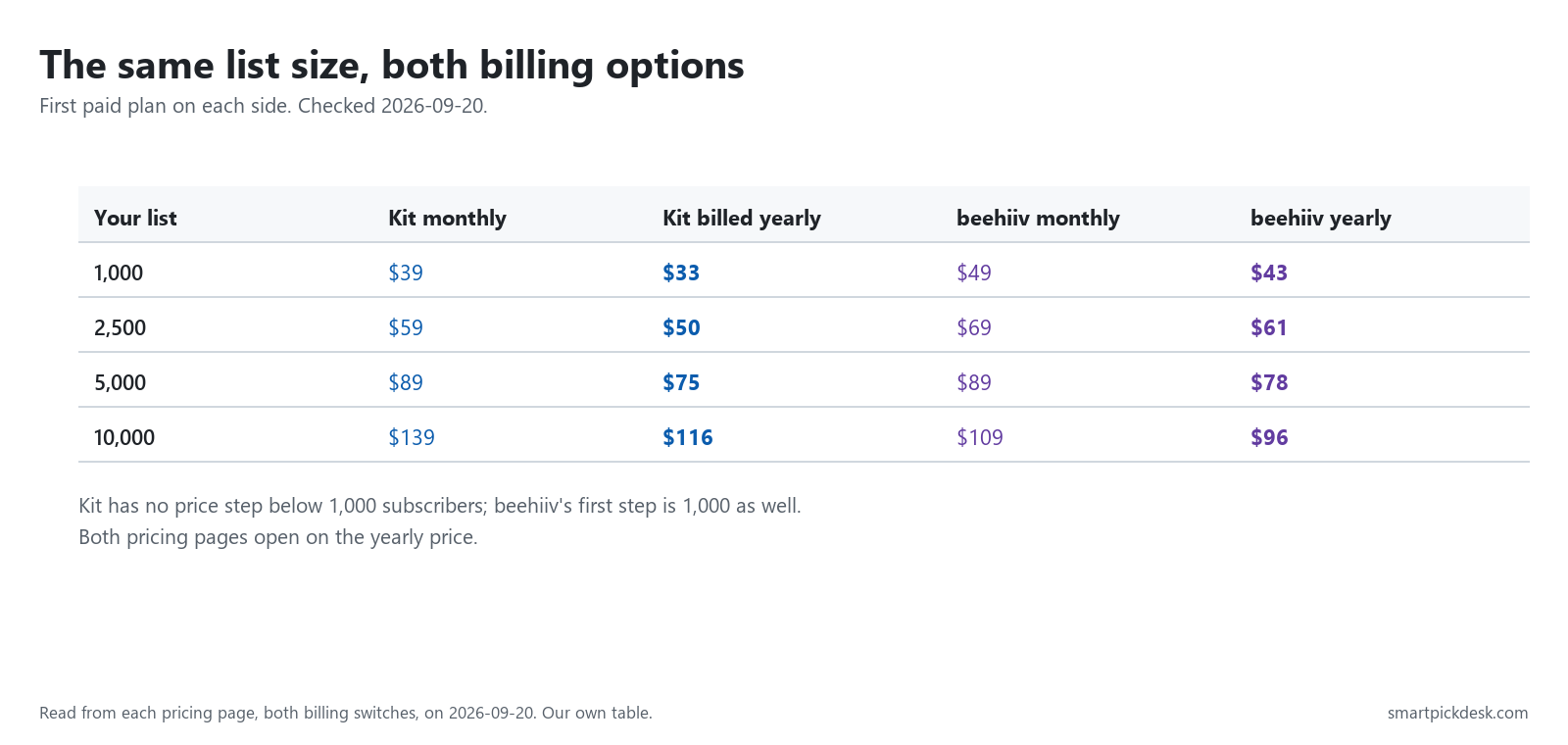
| Your list | Kit Creator, billed yearly | beehiiv Scale, billed yearly | Difference per month |
|---|---|---|---|
| 1,000 | $33[1] | $43[2] | Kit is $10 cheaper |
| 2,500 | $50[1] | $61[2] | Kit is $11 cheaper |
| 5,000 | $75[1] | $78[2] | Kit is $3 cheaper |
| 10,000 | $116[1] | $96[2] | beehiiv is $20 cheaper |
Look at the third row. At 5,000 subscribers the gap has almost closed — three dollars a month — and by 10,000 it has reversed and widened. If your list is around five thousand, the two are effectively the same price, and the decision should be made on what the plans contain rather than what they cost. Below that, Kit is meaningfully cheaper. Above it, beehiiv is.
Kit's slider has no step below 1,000 subscribers, and beehiiv's first step is 1,000 as well, so the comparison starts there. The plans are not feature-identical, so this is a price comparison, not a value judgement.
The two free plans
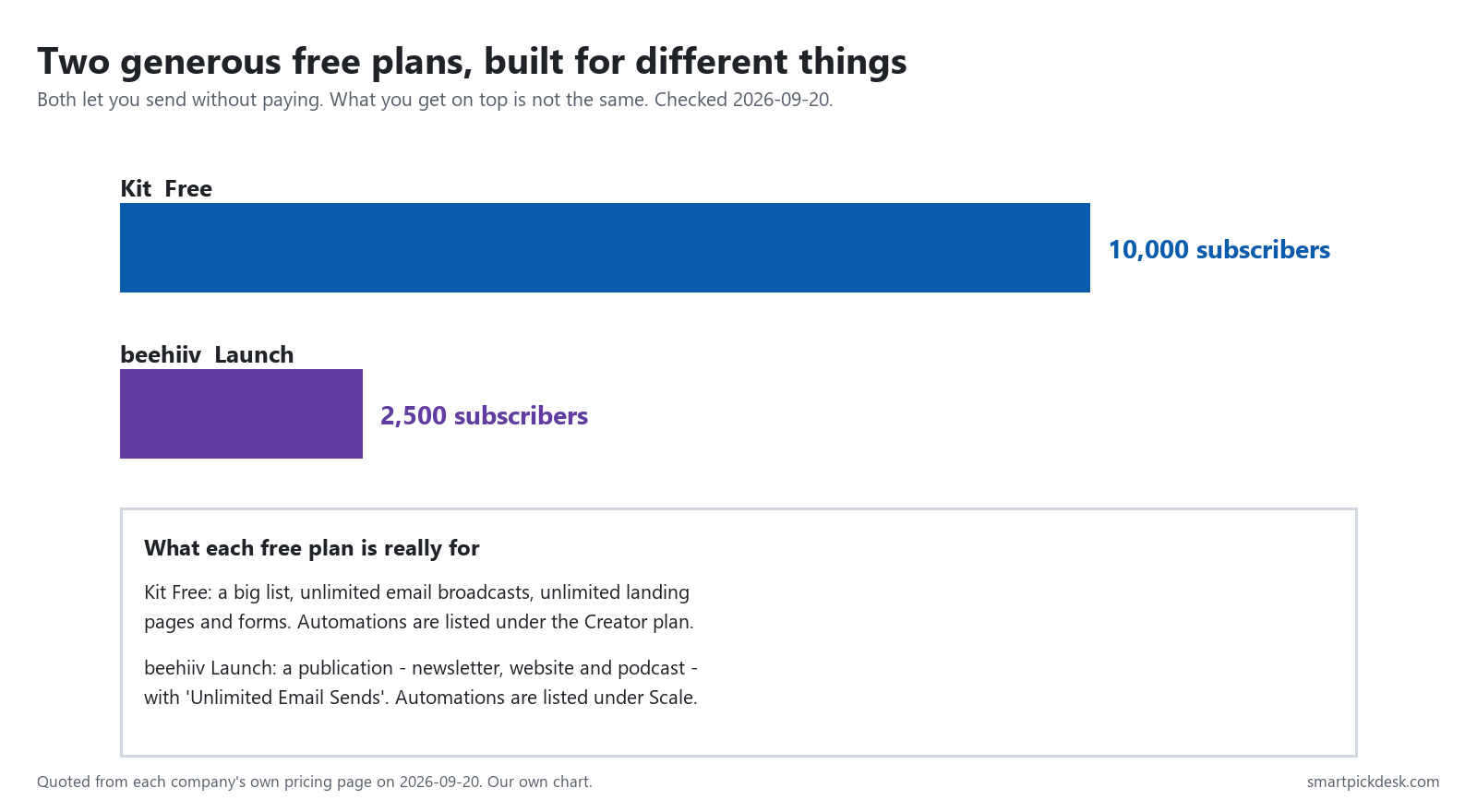
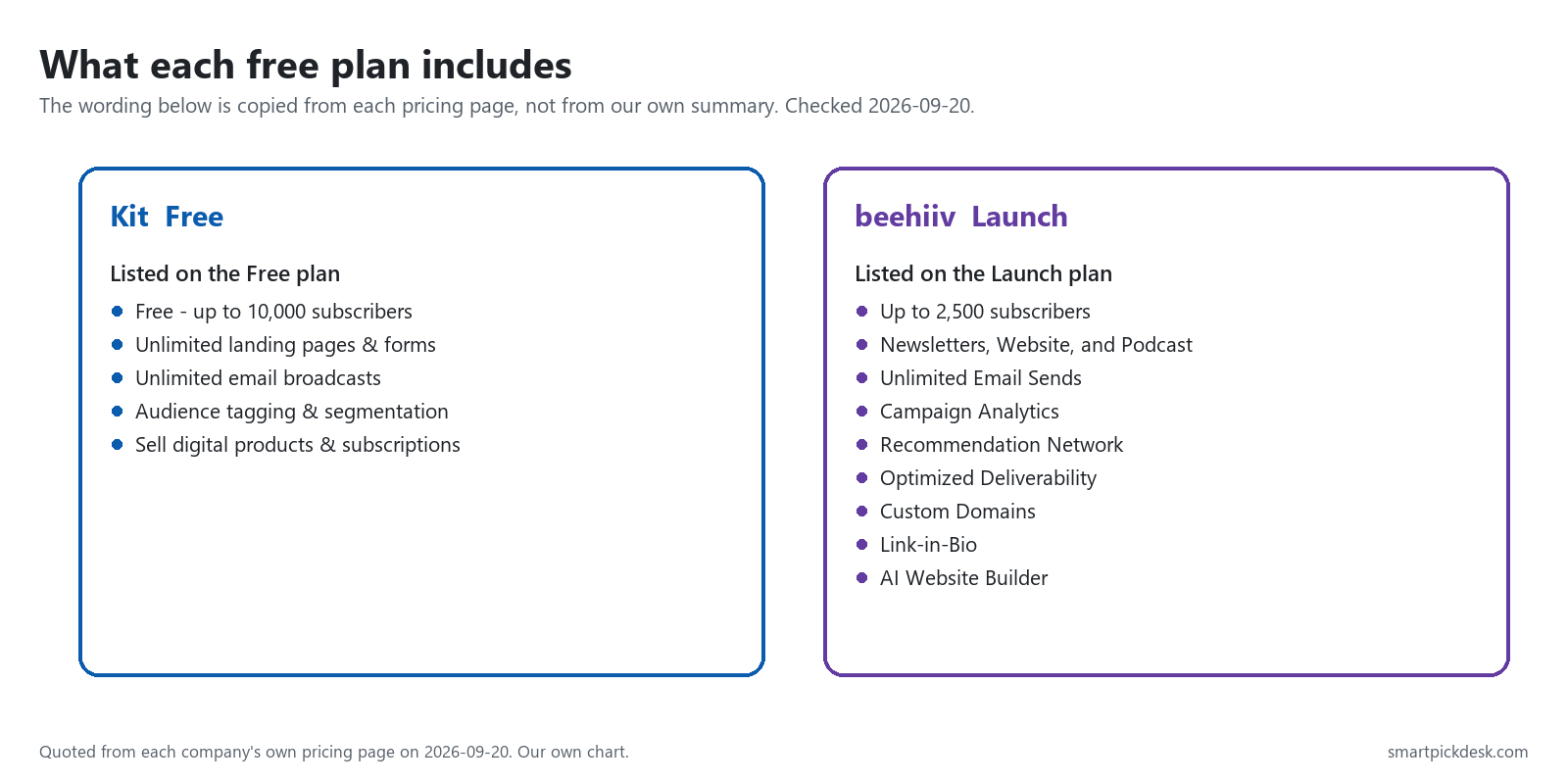
Both of these are unusually generous free plans, but they are generous about different things. Kit gives you room — four times the subscribers, unlimited broadcasts, unlimited landing pages and forms.[1] beehiiv gives you a publication — a newsletter, a website and a podcast, on a custom domain, with unlimited sends.[2]
| Limit type | Kit Free | beehiiv Launch |
|---|---|---|
| Subscribers | up to 10,000[1] | up to 2,500[2] |
| Emails you can send | “Unlimited email broadcasts”[1] | “Unlimited Email Sends”[2] |
| Automations | not listed on Free[1] | not listed on Launch[2] |
| A website for the newsletter | not listed on Free[1] | “Newsletters, Website, and Podcast”[2] |
| Custom domain | not listed on Free[1] | “Custom Domains”[2] |
| Landing pages and forms | “Unlimited landing pages & forms”[1] | “Link-in-Bio”, “AI Website Builder”[2] |
Neither free plan has the second ceiling that catches people out elsewhere: both describe their sending as unlimited. The limit that will actually stop you is the subscriber count — and that is where they differ by four times.
Automations: both put it behind the paywall
An automation is the thing that sends a welcome email by itself when someone subscribes, then the next one a few days later. Neither free plan has it. Kit lists “Unlimited Visual Automations” and “Unlimited email sequences” under Creator.[1] beehiiv lists “Email Automations” under Scale.[2]
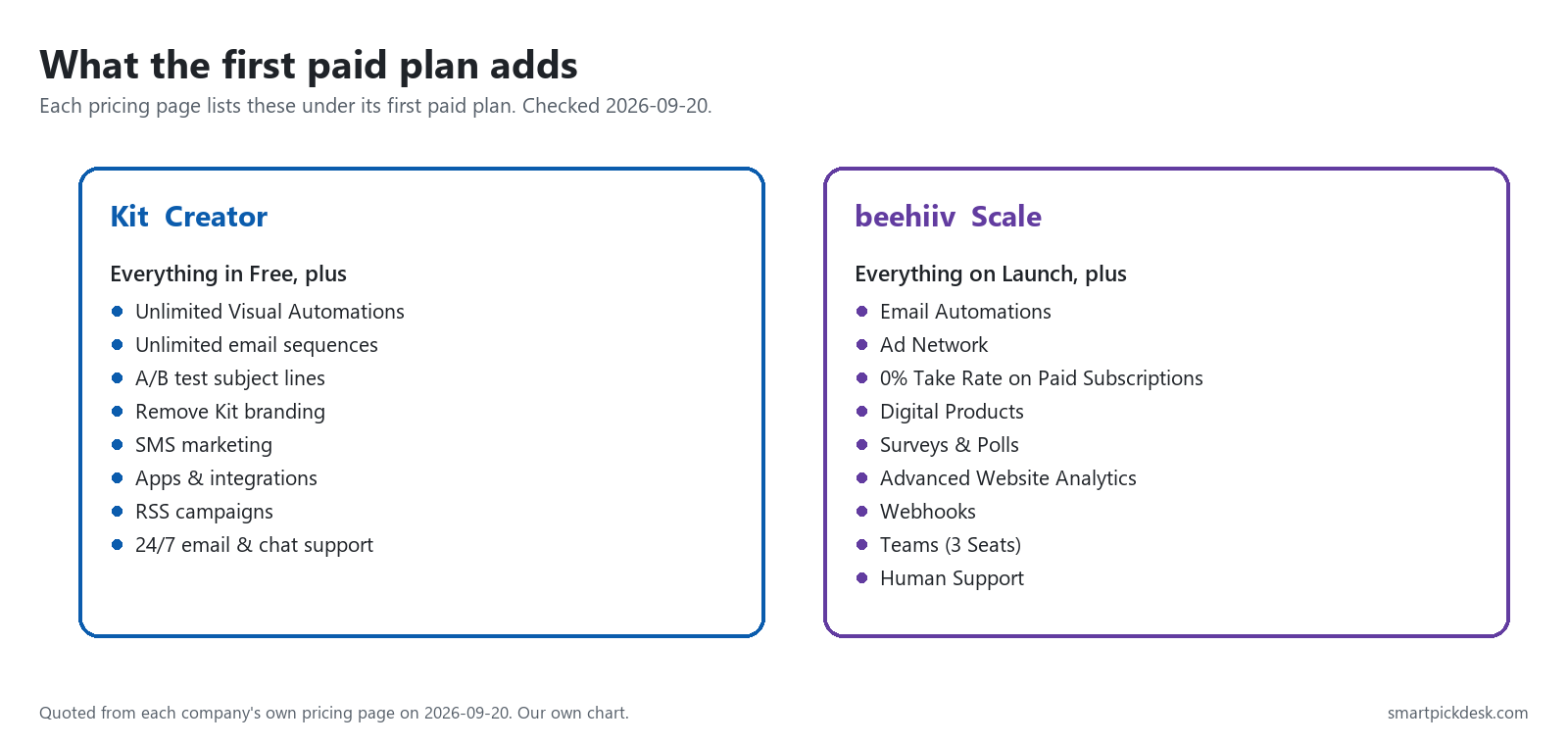
That makes this comparison simpler than most: if you need automation from day one, you are choosing between two paid plans, and the crossover chart above is the whole decision. If you do not, you are choosing between two free plans, and the question is whether you want room for 10,000 subscribers or a website and a podcast.
Monthly or yearly: the same plan at two prices
Both pricing pages open on the yearly price, and both print the saving next to it.
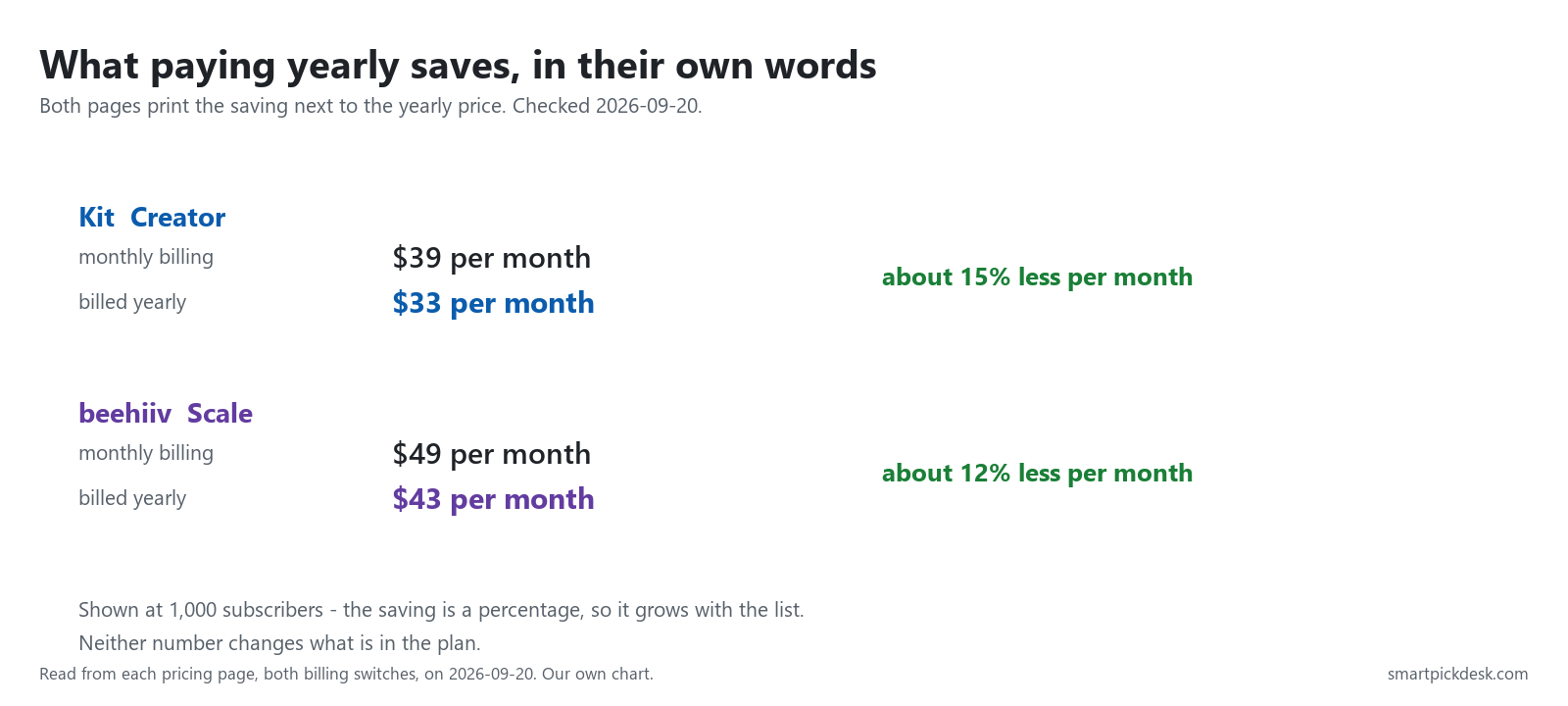
At 1,000 subscribers, Kit Creator is $39 per month billed monthly and $33 billed yearly ($390 for the year).[1] beehiiv Scale is $49 billed monthly and $43 billed yearly ($517 for the year, labelled “Save $71/year”).[2] The practical point is the default: the price you glanced at on either page was the yearly one.
A list, or a publication
Underneath the numbers these two products are answering different questions, and their free plans say so out loud.
Kit's free plan is built around collecting and mailing people: unlimited forms, unlimited landing pages, unlimited broadcasts, tagging and segmentation.[1] beehiiv's free plan is built around publishing: a newsletter with its own website and podcast, a custom domain, a link-in-bio page, campaign analytics and a “Recommendation Network”.[2]
That shows up in small places as well as large ones. One of them counts what you can build around the newsletter; the other counts what you can do with the people on it. Neither framing is wrong, and neither company is hiding it — it is written on the front of both pricing pages, in the order the features are listed.
Which means the honest version of the question is not “which tool is better” but “is the newsletter the thing I am making, or the way I reach people for something else I am making?” The first points at beehiiv, the second at Kit — and that is true at any price.
Selling and sponsorships
Kit lists “Sell digital products & subscriptions” on its free plan.[1] beehiiv lists “Digital Products” and “0% Take Rate on Paid Subscriptions” under Scale, and adds a “Sponsorship Storefront” under Max.[2] beehiiv also lists an “Ad Network” from Scale upward, which Kit's pricing page does not have an equivalent for under that name.
Neither pricing page prints a transaction-fee percentage for selling, so we cannot compare that here. If selling is the reason you are choosing, that number is worth finding before the monthly price matters — it is usually larger.
Getting the platform's name off your emails
A small difference that costs real money. Kit lists “Remove Kit branding” under Creator — its first paid plan.[1] beehiiv lists “Remove beehiiv Branding” under Max — its second.[2] At 1,000 subscribers that is $33 a month billed yearly on Kit against $96 on beehiiv, if unbranded email is a requirement rather than a preference.
What we could not test — and what each page claims about it
There is a whole half of this comparison we are not qualified to write. Whether an editor is pleasant, whether the templates are any good, whether emails land in the inbox, whether support answers — those need an account and months of use, and we have neither. Reviewers who do run both products cover exactly those areas, and for that half of the question you should read one of them rather than us.
What we can do is show you where each company puts those features in its plans, because that is printed on the pricing pages and it decides what you pay.
| Area we did not test | Where Kit lists it | Where beehiiv lists it |
|---|---|---|
| Deliverability | “Deliverability reporting” under Pro, the second paid plan[1] | “Optimized Deliverability” on the free Launch plan[2] |
| Analytics | “Engagement analytics” and “Insights dashboard” under Pro[1] | “Campaign Analytics” on Launch; “Advanced Website Analytics” under Scale[2] |
| Integrations and API | “Apps & integrations” under Creator[1] | “API Access (excluding Send API)” on Launch; “Webhooks” under Scale[2] |
| Support | “24/7 email & chat support” under Creator; “24/7 priority” under Pro[1] | “Human Support” under Scale; “Priority Human Support” under Max[2] |
| Referrals and growth | “Newsletter referral system” under Pro[1] | “Recommendation Network” on Launch[2] |
That table is worth a second read, because it is the pattern underneath the price. Several things Kit keeps for its second paid plan, beehiiv lists on its free one — deliverability, campaign analytics, referrals. Whether they are equally good we cannot tell you. Which plan you have to buy to get them at all, we can.
We also wanted to put third-party ratings here, with the review count and the date we read them. Both of the review sites we tried refused automated access on 2026-09-20, so there is nothing in this space rather than a number we could not verify.
Where each one is weaker
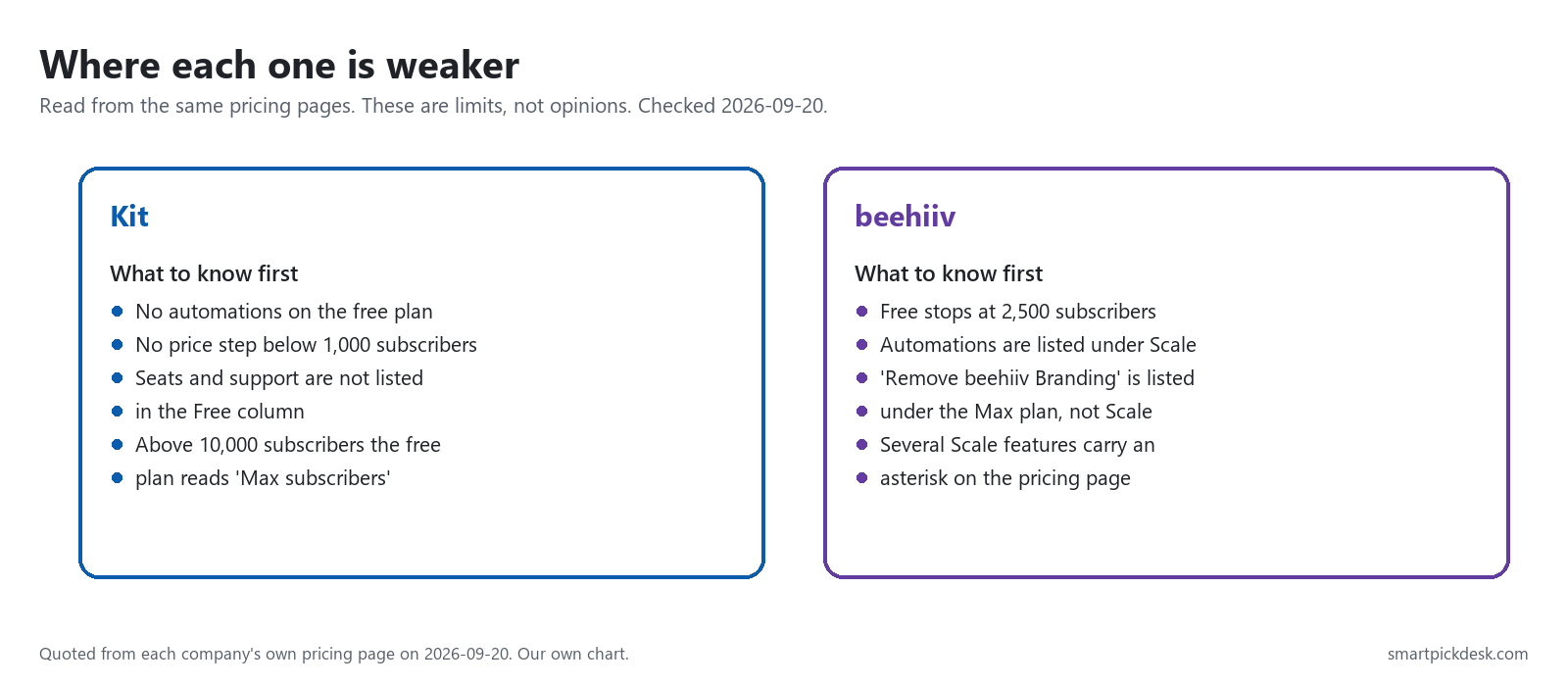
Kit: what to know before you commit
- No automations on the free plan, and no price step below 1,000 subscribers — the entry price is the same for a list of 200.[1]
- The free plan's other limits are not printed. Seats and support level are not listed among the Free plan's key features.[1]
- The paid price climbs faster. From 1,000 to 10,000 subscribers it goes from $33 to $116 billed yearly; beehiiv goes from $43 to $96 over the same range.[1][2]
beehiiv: what to know before you commit
- Free stops at 2,500 subscribers, a quarter of Kit's ceiling.[2]
- Branding removal is two plans up, not one.[2]
- Several Scale features carry an asterisk on the pricing page, which usually signals a condition we cannot read from the page itself — so we are not describing what those conditions are.[2]
Who should pick which
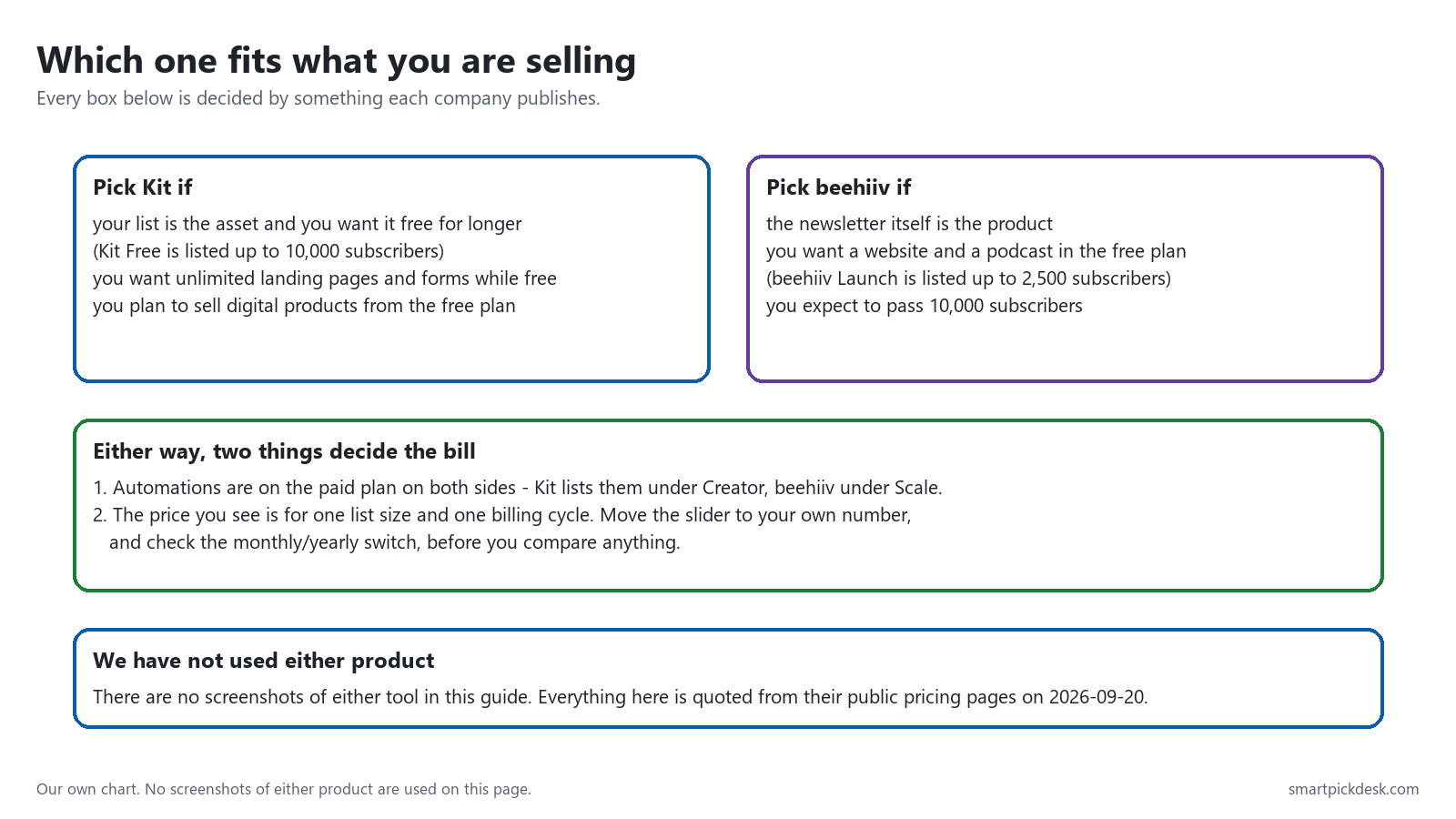
| If you are… | Pick | Why | Watch out for |
|---|---|---|---|
| Starting out with no list and no automation yet | Kit | Free up to 10,000 subscribers, unlimited broadcasts, unlimited forms[1] | The day you want a welcome sequence, it is $33/mo billed yearly, not $0 |
| Building the newsletter as the product | beehiiv | Launch includes the website and podcast, on a custom domain[2] | Free stops at 2,500 subscribers |
| Already past 10,000 subscribers and paying | beehiiv | $96 against $116 per month billed yearly at 10,000[1][2] | Compare the plan contents, not only the price |
| Selling digital products early | Kit | Selling is listed on the free plan[1] | Neither page prints the transaction fee |
| Required to send unbranded email | Kit | Branding removal is on the first paid plan[1] | On beehiiv it is on Max[2] |
See Kit's own pricing page See beehiiv's own pricing page
Comparing a third option? See Kit vs MailerLite: where the free plans actually stop.
Looking at more than two? What “free” actually means on 8 email platforms compares every free plan we could read.
Questions people ask
Which one is cheaper?
It flips. Billed yearly, Kit Creator is $33 a month at 1,000 subscribers against beehiiv Scale at $43; at 10,000 it is Kit $116 against beehiiv $96.[1][2] The swap happens between 5,000 and 10,000.
How big is each free plan?
Kit: “Free—up to 10,000 subscribers”.[1] beehiiv Launch: “Up to 2,500 subscribers” with “Unlimited Email Sends”.[2]
Can I automate emails on the free plan?
Not on either. Kit lists automations under Creator, beehiiv under Scale.[1][2]
Does beehiiv really include a website and a podcast for free?
The Launch plan lists “Newsletters, Website, and Podcast”, plus “Custom Domains” and an “AI Website Builder”.[2] We have not used them, so we are only reporting what the page lists.
What about removing the platform's branding?
Kit puts it on its first paid plan; beehiiv puts it on its second.[1][2]
Do you get paid if I sign up?
Not from this page — it has no affiliate links today. If that changes, it will say so at the top, and each link will be marked.
Sources and check log
| # | Source | URL | Checked | How |
|---|---|---|---|---|
| 1 | Kit, Pricing (plans, the “Compare plans and features” slider and the yearly/monthly switch) | kit.com/pricing | 2026-09-20 | Opened in a browser; every slider step and both billing positions recorded |
| 2 | beehiiv, Pricing (Launch, Scale, Max, the subscriber slider and the monthly/annual switch) | beehiiv.com/pricing | 2026-09-20 | Opened in a browser; all nine subscriber steps recorded under both billing options |
Change log
- 2026-09-20 — First published. All prices and plan wording read from the two pricing pages on this date.
- Previous check: none — this is the first version of this page.
- What we will re-check: the price at each step of both sliders, the two free plan ceilings, and whether the crossover point moves.
Who writes this
Smart Pick Desk is an independent site that compares tools for people who work online. We are not employed by, or partnered with, either company on this page, and we do not run either product in our own business. What we do is read what each company publishes, write down the date we read it, and say plainly which parts we could not check. More about this site.
We do not promise results. Nothing here is a prediction about what a tool will do for your list.