Systeme.io pricing, checked: what the free plan includes and when you start paying
Last updated 2026-09-23 · Prices and terms read on Systeme.io's own pages on 2026-09-23 · We have not used Systeme.io · How we checked ↓
The short answer
Systeme.io lists four prices: $0, $17, $47 and $97 a month. What moves you from one to the next is mostly your number of contacts, plus one rule that is in the terms rather than on the pricing page.
- Start on Free if your list is under 2,000 contacts and you are trying the platform. The Free card reads “3 funnels, 1 automation rule, 1 custom domain, and up to 2,000 contacts” and says “No credit card required”.[1] The tight limits are not the contacts but the ones: 1 automation rule, 1 email campaign, 1 workflow, 1 tag.[1]
- Expect to pay once you pass 2,000 contacts or need a second automation rule. Startup is $17 a month or $170 billed yearly, Webinar $47 or $470, Unlimited $97 or $970.[1] Yearly is ten months' price for twelve.
- Before you pay, read two lines of the terms. On a paid plan, going over a limit starts a 3-day period to cut back, after which the plan is upgraded automatically.[2] And: “Please note that our subscription plans are not refundable.”[2]
If you want one sentence: Free has no end date, but what you pay later depends on your contact count and on a 3-day rule you will only find in the terms.
On this page
At a glance
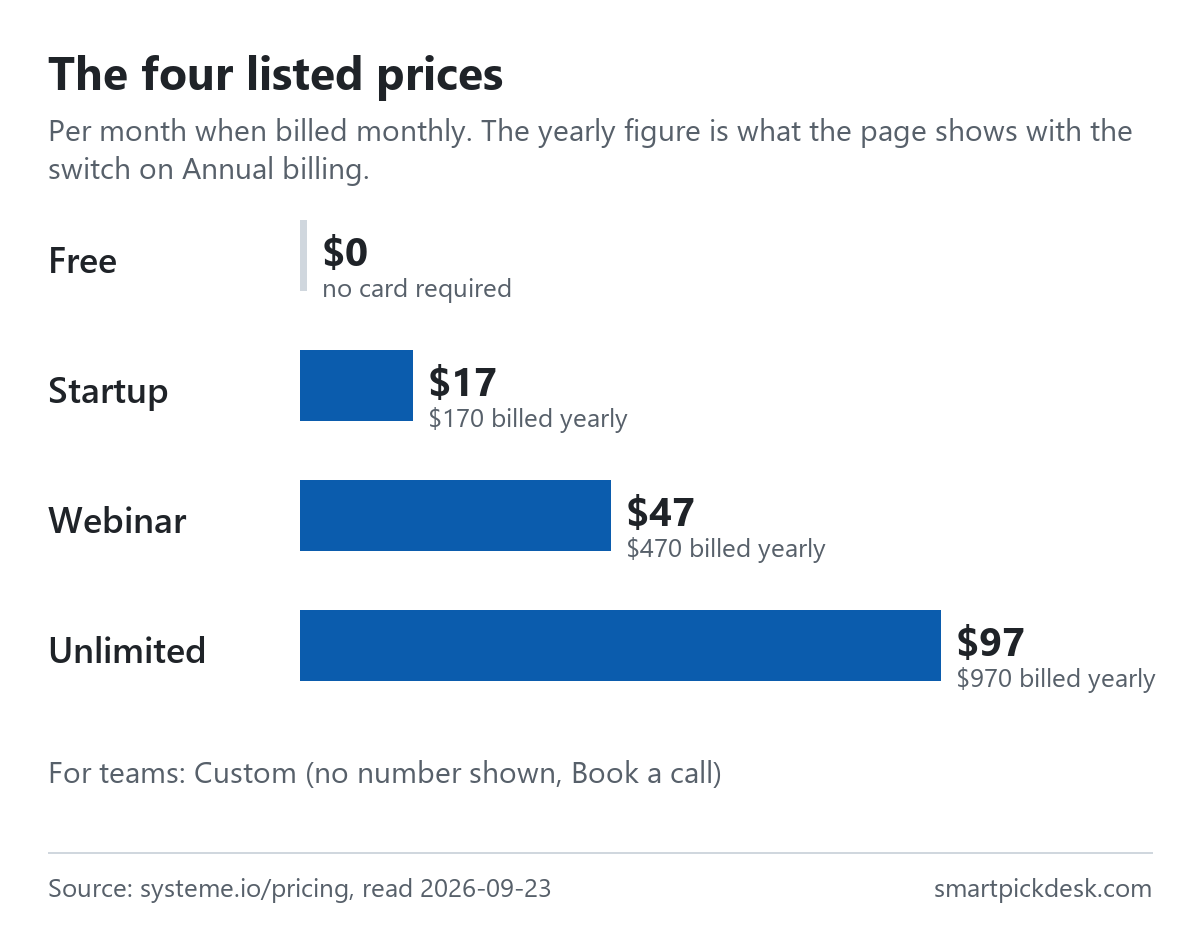
| Plan | Monthly billing | Annual billing | Contacts | Sales funnels | Automation rules |
|---|---|---|---|---|---|
| Free | $0 | $0 | 2,000 | 3 | 1 |
| Startup | $17 | $170 | 5,000 | 10 | 10 |
| Webinar | $47 | $470 | 10,000 | 50 | 100 |
| Unlimited | $97 | $970 | Unlimited | Unlimited | Unlimited |
| For teams | Custom, with no number shown (Book a call). The card reads “Everything in Unlimited, plus a dedicated success manager and support built for teams.” | ||||
All values from the plan cards and the comparison table on the pricing page.[1] With the switch on Annual billing, the cards show $170, $470 and $970 next to a “2 months free” badge. The page text we saved prints no unit beside those numbers; the FAQ gives the monthly prices as $17/month, $47/month and $97/month, and each annual figure is exactly ten times the monthly one.
How we checked this (and what we did not check)
Last updated 2026-09-23 (first version). Every number and quotation on this page was read from Systeme.io's own pricing page and its terms and conditions on 2026-09-23. Prices change — confirm on the official page before you sign up.
What we did. On 2026-09-23 we opened systeme.io/pricing in a browser with no account and saved the page text as displayed, first with the billing switch on Monthly, then again after switching it to Annual. We did the same for the terms and conditions. Wording in quotation marks is copied from those saved pages word for word, and a script checks every quotation on this page against the saved text.
What we did not do. We have not used Systeme.io. There is no account, no screenshot of the product, no test funnel and no opinion here about how the editor feels or how quickly support answers. We have not asked Systeme.io about the disagreements described below. Some rows of the comparison table are shown as tick marks rather than text, and our method reads text, so we could not record which plans have those features; they are listed under What the pricing page does not tell you.
What that leaves. What the pricing page and the terms say, read on one date and put in one place — including the places where they do not agree with each other.
What the free plan includes
The Free card lists four numbers and calls the plan “Perfect for testing the platform”.[1] The comparison table fills in the rest.
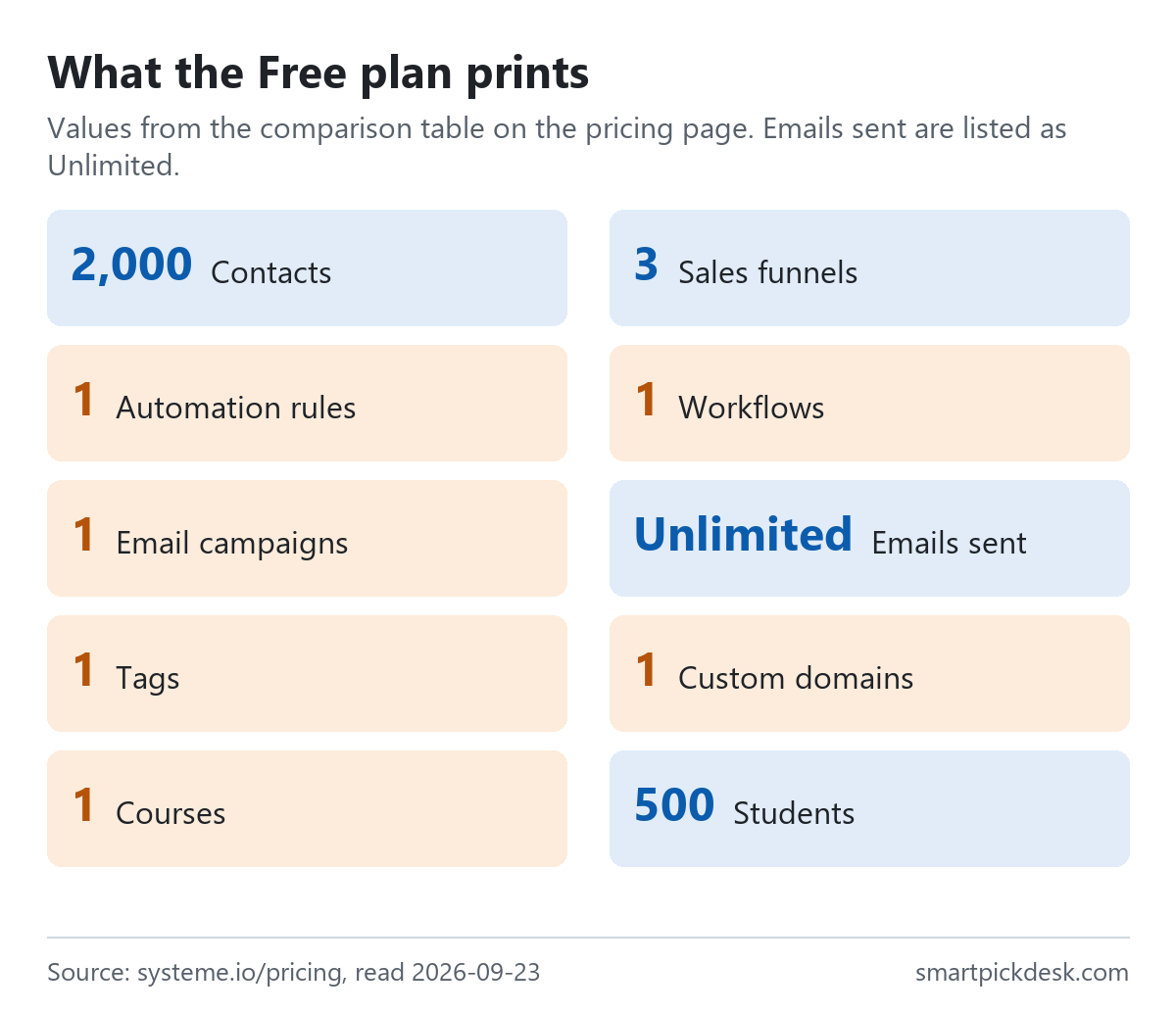
The FAQ on the same page describes the free plan like this: “the free plan supports up to 2,000 contacts, 3 sales funnels, 1 blog, 1 course”, and “Emails and file storage are unlimited. The free plan never expires and does not require a credit card.”[1]
The same FAQ says “The only meaningful limits are on funnels and courses”.[1] Read that next to the table: the table also prints 1 for automation rules, workflows, email campaigns and tags on Free. Whether a limit of one matters depends on how you work. The table lists email campaigns and email newsletters as separate rows, with newsletters shown as Unlimited on every plan, and the page does not define the difference. We are not going to guess at it.
What that means in practice: if you plan to use more than one tag or more than one automation rule, those limits of one arrive long before the limit of 2,000 contacts does. If you want one list, one funnel and a place to try things, the free plan is built for exactly that, and it has no end date.
The paid plans, line by line
Each paid card is one sentence with four numbers in it:
- Startup: “Expand your capacity with up to 10 funnels, 10 automation rules, 3 custom domains, and 5,000 contacts”.[1]
- Webinar: “Unlock evergreen webinars and get up to 50 funnels, 100 automation rules, 10 custom domains, and 10,000 contacts”.[1]
- Unlimited: “Get complete freedom with unlimited funnels, contacts, automation rules, and custom domains, plus early access to new features”.[1]
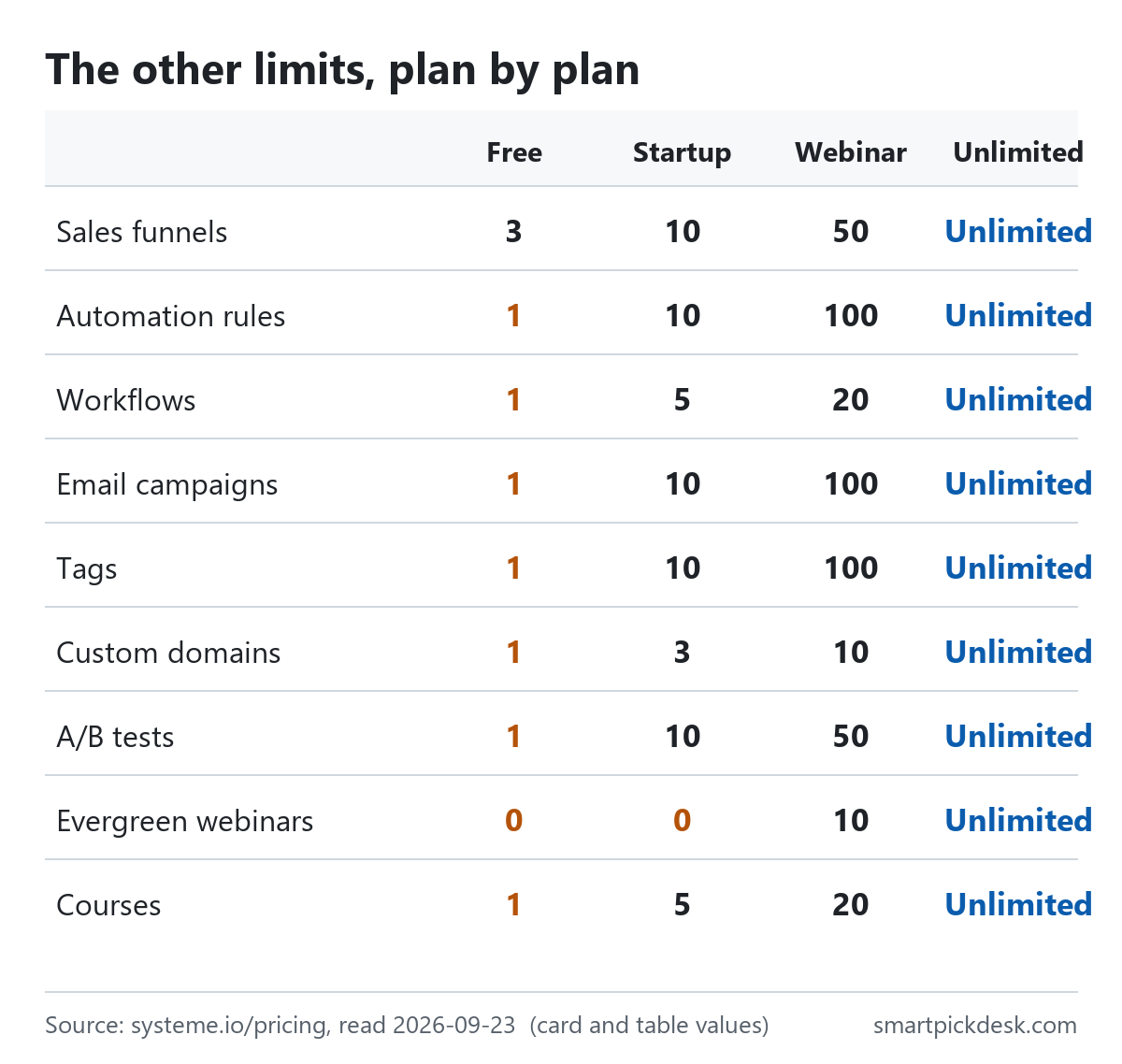
| Line in the table | Free | Startup | Webinar | Unlimited |
|---|---|---|---|---|
| Contacts | 2,000 | 5,000 | 10,000 | Unlimited |
| Emails sent | Unlimited | Unlimited | Unlimited | Unlimited |
| Email campaigns | 1 | 10 | 100 | Unlimited |
| Tags | 1 | 10 | 100 | Unlimited |
| Automation rules | 1 | 10 | 100 | Unlimited |
| Workflows | 1 | 5 | 20 | Unlimited |
| Sales funnels | 3 | 10 | 50 | Unlimited |
| Sales funnel steps | 15 | 50 | 300 | Unlimited |
| Evergreen webinars | 0 | 0 | 10 | Unlimited |
| A/B tests | 1 | 10 | 50 | Unlimited |
| Custom domains | 1 | 3 | 10 | Unlimited |
| Websites, blogs, courses, communities | 1 each | 5 each | 20 each | Unlimited |
| Students | 500 | Unlimited | Unlimited | Unlimited |
| Coupon codes | 1 | 10 | 50 | Unlimited |
| Sub-accounts | Unlimited | Unlimited | Unlimited | Unlimited |
| Transaction fees | 0% | 0% | 0% | 0% |
Values as printed in the comparison table on 2026-09-23.[1] Rows shown only as tick marks are not included; see below.
Read across, each step roughly multiplies the working limits: Startup lifts Free's ones to tens, Webinar lifts those to fifties and hundreds, and Webinar is the first plan where the table lists evergreen webinars at all (10). Students go from 500 on Free to Unlimited on every paid plan, which matters only if you sell courses.
Monthly or yearly: ten months' price for twelve
The page opens on Monthly billing. Switch it to Annual billing and the cards show $170, $470 and $970, and a “2 months free” badge appears.[1] Each yearly figure is exactly ten times the monthly price.
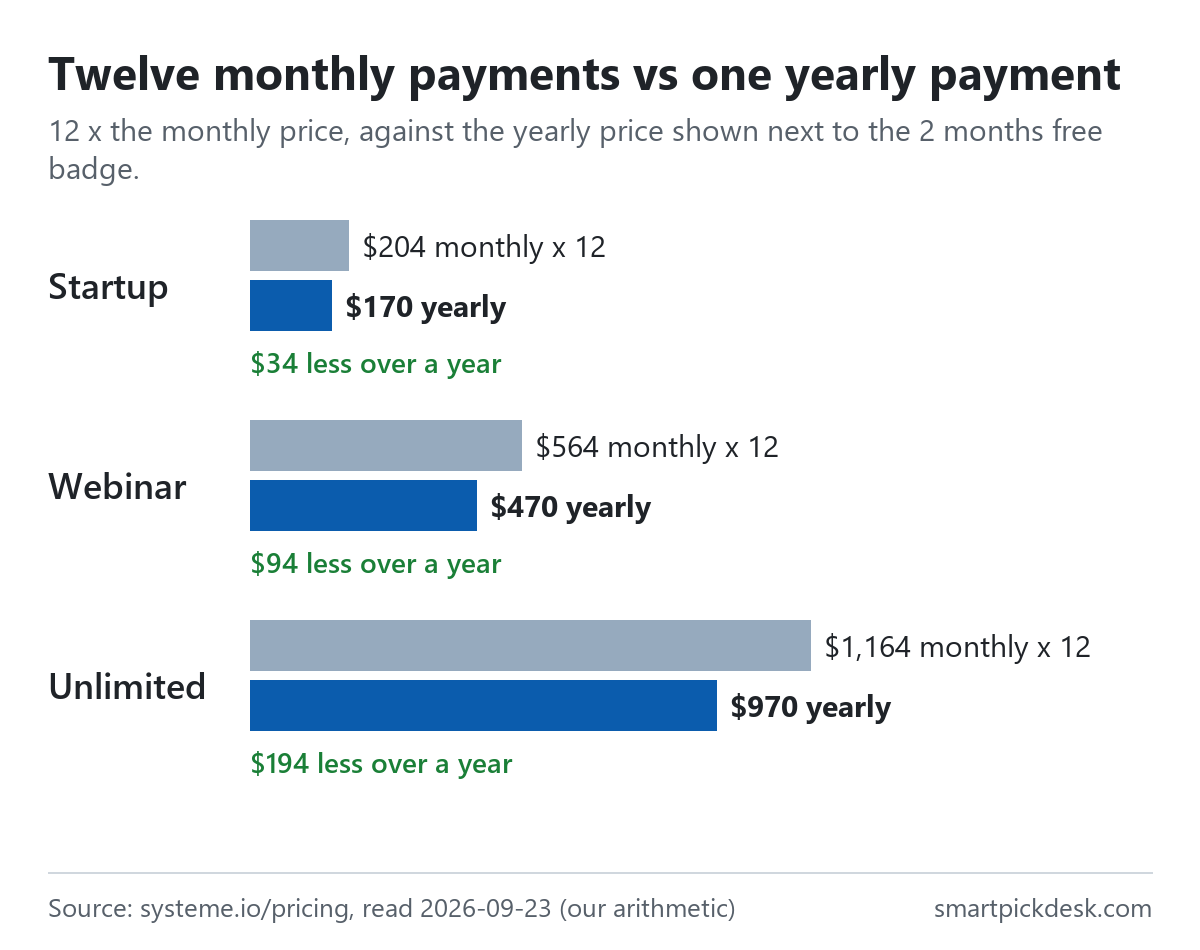
| Plan | Monthly price | 12 monthly payments | Billed yearly | Less over a year |
|---|---|---|---|---|
| Startup | $17 | $204 | $170 | $34 |
| Webinar | $47 | $564 | $470 | $94 |
| Unlimited | $97 | $1,164 | $970 | $194 |
Monthly and yearly prices from the pricing page.[1] The 12-month and difference columns are our arithmetic.
Two things to weigh before choosing yearly. First, Article 3 of the terms says “Please note that our subscription plans are not refundable.”[2] Second, the same article says “The price of items can be changed at any time. However, the price applied to an order will be the one stated at the time of the order.”[2] Put side by side, choosing yearly means paying for the year up front under a no-refund term, at the price shown on the day you order.
When you start paying
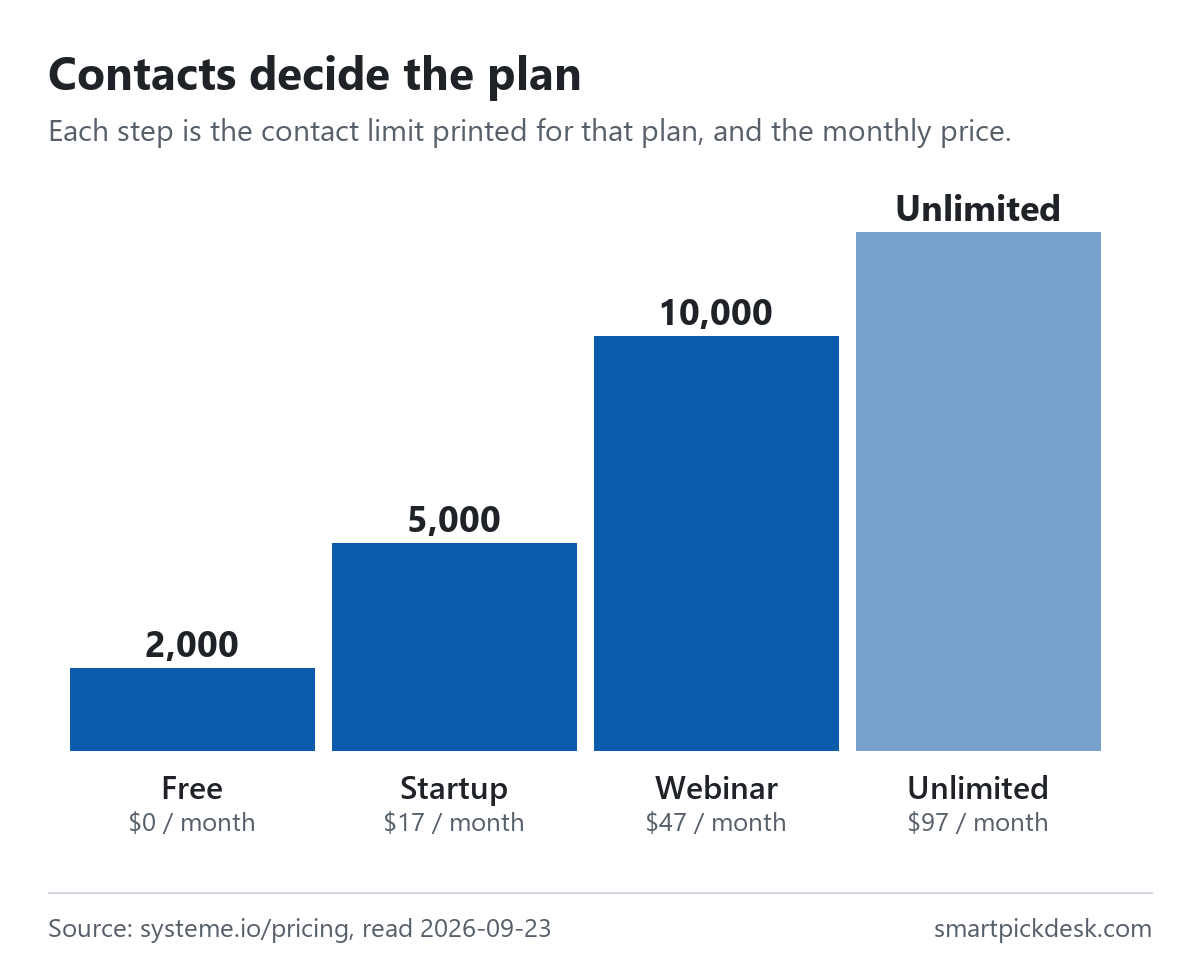
The FAQ says Systeme.io “has four plans based primarily on contact limits”[1] and gives its own rule of thumb by list size:
- “Under 2,000 contacts: use the free plan”
- “2,000 to 5,000 contacts: Startup at $17/month.”
- “5,000 to 10,000 contacts: Webinar at $47/month (also adds automated webinar funnels).”
- “Over 10,000 contacts or if you manage clients: Unlimited at $97/month.”[1]
Contacts are only one of the triggers. On the card and table values, you also move up a plan when you need:
- on Free, more than 3 funnels, more than 1 automation rule or more than 1 custom domain;
- on Startup, more than 10 funnels, 10 automation rules or 3 custom domains;
- on Webinar, more than 50 funnels, 100 automation rules or 10 custom domains;
- evergreen webinars at all — the table prints 0 for them on Free and Startup.
What the page does not say is how contacts are counted, for example whether unsubscribed contacts still count toward the limit. We did not find that on the pricing page or in the terms, so we do not state it here.
Where the pricing page disagrees with itself
On 2026-09-23 the pricing page said two different things about the same plans in three places. Both sides are quoted as printed.
- Startup funnels. The card says “Expand your capacity with up to 10 funnels” and the table lists 10 sales funnels.[1] The FAQ says “Startup ($17/month): 5,000 contacts, unlimited funnels, 5 courses.”[1]
- Webinar limits. The card says “get up to 50 funnels, 100 automation rules”, and the table agrees.[1] The FAQ says “Webinar ($47/month): 10,000 contacts, unlimited everything plus automated webinar feature.”[1]
- Sub-accounts. The table lists Sub-accounts as Unlimited on all four plans, Free included.[1] The FAQ names them among the features of the top plan: “Unlimited ($97/month): unlimited contacts, all features, sub-accounts, and free migration service.”[1]
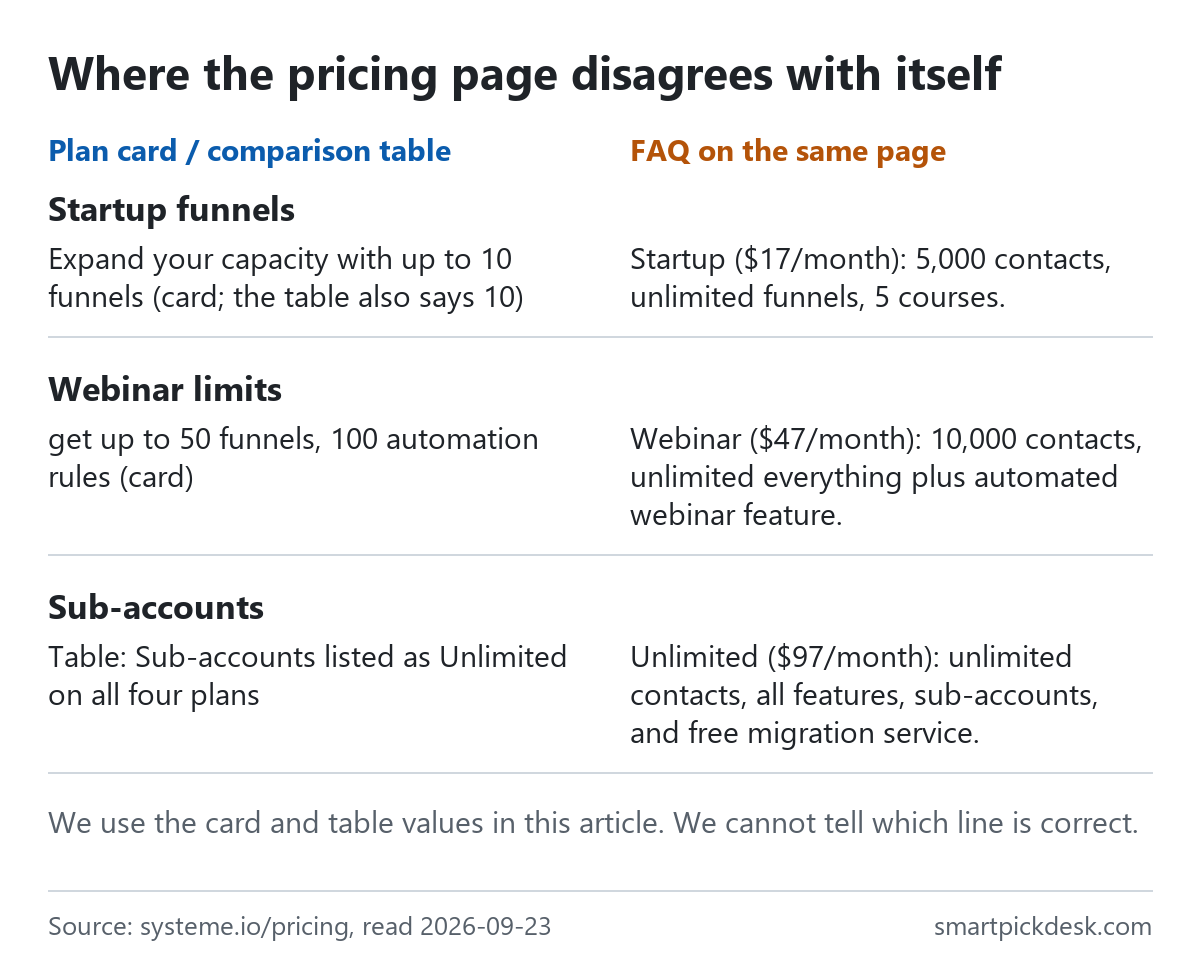
We cannot tell which line is correct, and we have not asked. In this article we use the card and table values, because they are the more specific ones and they agree with each other. If the difference matters to you — for example, you are choosing Startup because the FAQ says unlimited funnels — ask Systeme.io's support in writing before you pay, and keep the answer.
The FAQ ends with “Last updated: April 2026”.[1] That is a date on the FAQ, not necessarily the date the prices last changed.
Going over a limit on a paid plan: the 3-day rule
This is not on the pricing page. It is Article 5 of the terms and conditions, and it opens: “Certain paid plans are subject to specific usage limits (including, but not limited to, the number of contacts, sales funnels, and courses).”[2] The rest reads:
- “If your account usage exceeds the limits of your current paid plan, we will notify you via email.”
- “You will be provided with a 3-day period to reduce your usage (e.g., by deleting contacts or funnels) to stay within your plan's limits.”
- “If you do not reduce your usage within 3 days, your subscription will be automatically upgraded to the appropriate plan to ensure service continuity.”
- “By continuing to use the Service with usage levels that exceed your current plan's limits, you explicitly consent to this automatic upgrade” and “agree to be billed the price of the new plan for the remainder of the subscription period”.[2]
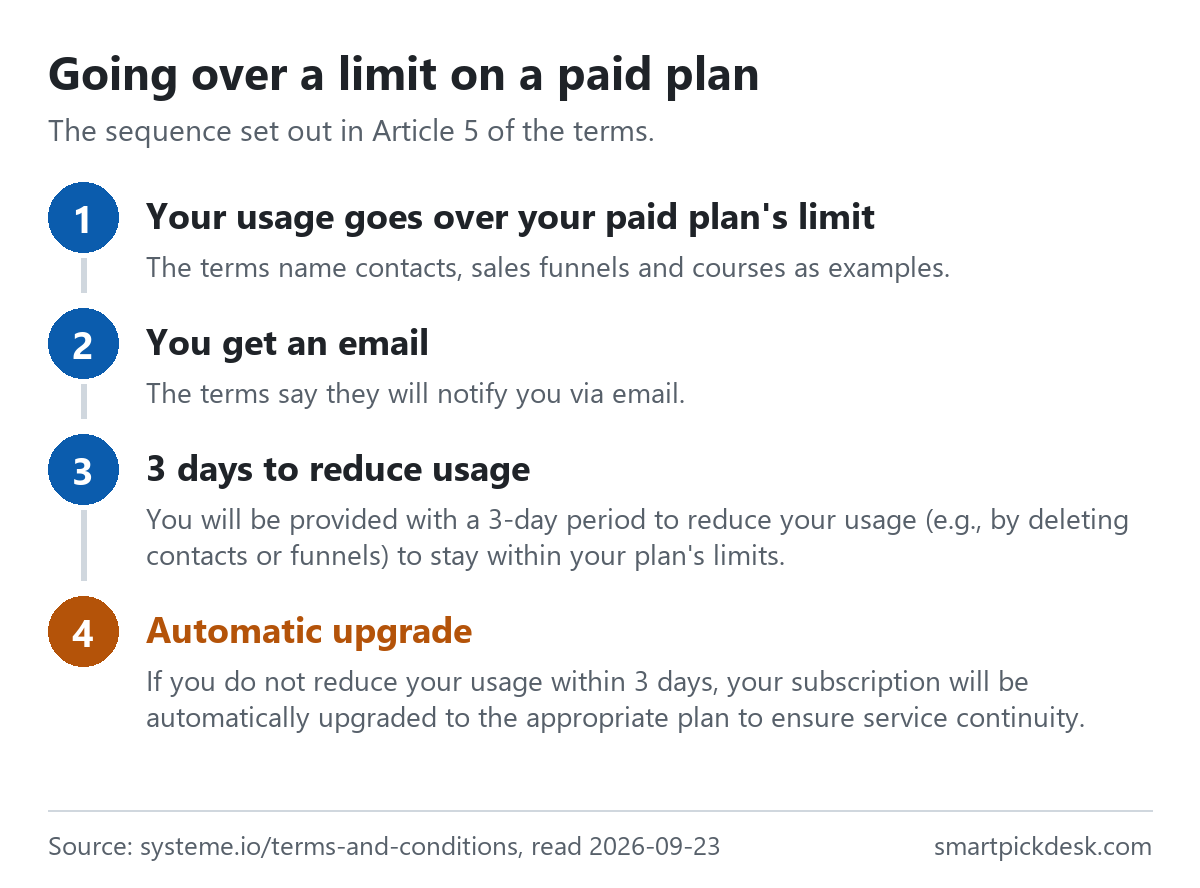
In plain terms: on a paid plan, a list or a funnel count that grows past your plan's limit starts a 3-day clock once the email arrives. If you do nothing, the plan changes and so does the price. The terms do not say how the appropriate plan is chosen. On the table values, the next plan up from Startup with a higher contact limit is Webinar, listed at $47 a month.
Two things the terms do not say, so we do not say them either: what happens on the Free plan when you go over its limits (Article 5 speaks of paid plans), and whether an account is moved back down if usage falls again later.
What to do with this: keep an eye on the email address on your account, and if your list is close to a limit, decide before you reach it whether you would rather clean the list or move up.
Refunds and currency
Article 3 of the terms, headed price, contains one line on refunds: “Please note that our subscription plans are not refundable.”[2] The pricing page does not mention refunds, and we found no exception in the terms.
Read with the 3-day rule above, the practical point is simple: an automatic upgrade is billed for the rest of the subscription period, and the terms describe subscription plans as not refundable.
The same article states the currency: “The prices are indicated in dollars, excluding the shipping and processing of your order.”[2] Article 4 adds that “Payment is due immediately on the date of the order”.[2] We did not find the words tax or VAT on the pricing page or in the terms, so check the checkout page if you pay tax where you live.
If you cancel: contacts above 2,000 are archived
The pricing page FAQ says “You can upgrade or downgrade your plan at any time from your account settings.”[1] On cancelling, it says two things:
- “If you cancel, your data remains accessible on the free plan as long as your contact count stays within the 2,000 limit.”
- “If you cancel and your list exceeds the free plan's contact limit, your account reverts to the free plan and contacts above the limit are archived — they are not deleted.”[1]
It ends: “You can reactivate a paid plan at any time to restore full access.”[1]
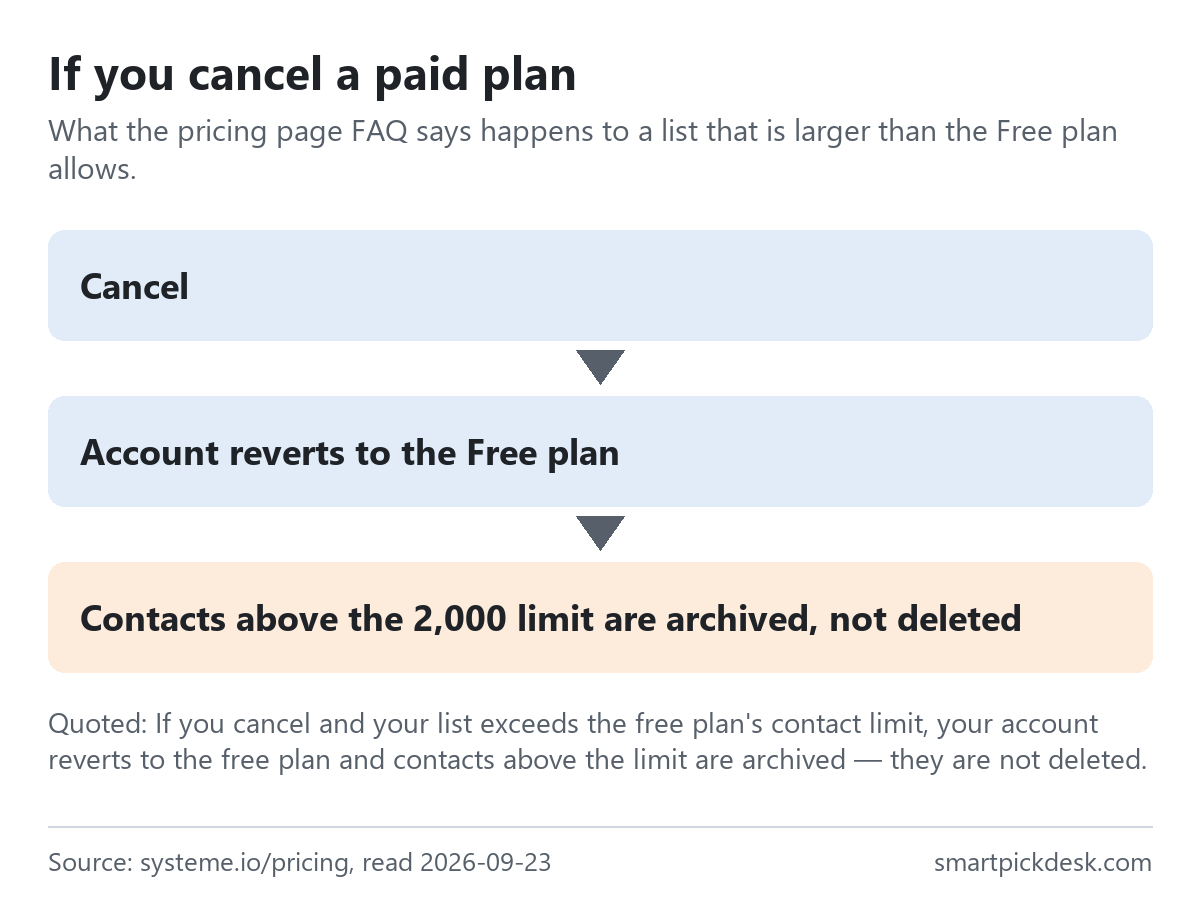
Not stated on either page: how long archived contacts are kept, which contacts are the ones archived, whether you can export them while they are archived, and what happens to funnels, courses or automation rules above the Free limits when you cancel. If any of those matter to you, ask before you cancel, not after.
What the pricing page does not tell you
- Which plans have the tick-mark features. The table has rows for Deadline funnels, 24/7 Email support, a 1-on-1 kickstart coaching session, SMS, several integrations, Free migration and Early access to new features. They are shown as icons, and our saved text records the row names but not which plans are ticked. In the annual view the words Free migration also appear beside the “2 months free” badge; the text alone does not show which plans that applies to.
- How a contact is counted. Not defined on the pricing page or in the terms.
- Tax. Neither page mentions it.
- That Unlimited has a few numbers. The table lists CRM Pipelines as 1, 5, 20 and 100, and API requests per minute as 30, 60, 120 and Unlimited. So the plan called Unlimited prints a number on at least one line.
- How a paid-plan overage is settled. That is in Article 5 of the terms, not on the pricing page (see the 3-day rule).
Which plan fits which situation
| If you are… | Look at | Why, from the page | Watch out for |
|---|---|---|---|
| Trying the platform with a small list | Free | 2,000 contacts, 3 funnels, no credit card, no end date[1] | 1 automation rule, 1 email campaign, 1 tag |
| Past 2,000 contacts, or needing more than one automation rule | Startup, $17 a month or $170 a year | 5,000 contacts, 10 funnels, 10 automation rules[1] | The FAQ says unlimited funnels; the card and table say 10 |
| Planning evergreen webinars | Webinar, $47 a month or $470 a year | The first plan with evergreen webinars (10)[1] | The FAQ says unlimited everything; the card says 50 funnels and 100 automation rules |
| Over 10,000 contacts | Unlimited, $97 a month or $970 a year | Contacts, funnels, automation rules and custom domains listed as unlimited[1] | CRM Pipelines listed as 100 |
| On a paid plan with a list close to its limit | Your current plan | Article 5 of the terms[2] | An email, 3 days, then an automatic upgrade |
| Thinking of paying yearly | Any paid plan | Ten months' price for twelve[1] | Plans are not refundable, per the terms[2] |
See Systeme.io's own pricing page Read Systeme.io's terms
Looking at free plans on dedicated email tools instead? What “free” actually means on 8 email platforms compares every free plan we could read.
Questions people ask
Is the Systeme.io free plan really free with no end date?
The pricing page FAQ says “The free plan never expires and does not require a credit card.”[1] The Free plan is listed with 2,000 contacts, 3 funnels, 1 automation rule and 1 custom domain.
How many funnels does the Startup plan include?
The plan card and the comparison table say 10. The FAQ on the same page says “unlimited funnels”.[1] We use 10 and cannot tell which is correct; if it matters to you, ask Systeme.io in writing before you pay.
What happens if I go over my plan's limit?
On a paid plan, Article 5 of the terms says you will be notified by email and given a 3-day period to reduce your usage. If you do not, “your subscription will be automatically upgraded to the appropriate plan to ensure service continuity.”[2] This is in the terms, not on the pricing page.
Can I get a refund on a Systeme.io plan?
Article 3 of the terms says: “Please note that our subscription plans are not refundable.”[2] We found no exception in the terms.
What happens to my contacts if I cancel?
The pricing page FAQ says your account reverts to the free plan and “contacts above the limit are archived”, and that they are not deleted.[1] It does not say how long they are kept.
Is yearly billing cheaper?
The yearly prices are $170, $470 and $970, each ten times the monthly price, shown next to a “2 months free” badge.[1] Over a year that is $34, $94 and $194 less than twelve monthly payments. The terms say subscription plans are not refundable.[2]
Do you get paid if I sign up?
Not from this page — we have signed up to Systeme.io's affiliate programme, but this page has no affiliate links today. If that changes, it will say so at the top, and each link will be marked.
Sources and check log
| # | Source | URL | Checked | How |
|---|---|---|---|---|
| 1 | Systeme.io, Pricing (plan cards, the Monthly/Annual billing switch, the “Compare plans & features” table and the FAQ) | systeme.io/pricing | 2026-09-23 | Opened in a browser with no account; page text saved in both billing positions |
| 2 | Systeme.io, Terms and conditions (Articles 3, 4 and 5) | systeme.io/terms-and-conditions | 2026-09-23 | Opened in a browser with no account; page text saved |
Change log
- 2026-09-23 — First version. All prices, limits and wording read from the two pages above on this date.
- Previous check: none (first version).
- What we will re-check: the four prices in both billing positions, the three places where the card or table and the FAQ disagree, and Articles 3 and 5 of the terms.
Who writes this
Smart Pick Desk is an independent site that compares tools for people who work online. We are not employed by Systeme.io, and we do not run it in our own business. We have signed up to Systeme.io's affiliate programme; this page does not contain an affiliate link today. What we do is read what each company publishes, write down the date we read it, and say plainly which parts we could not check. More about this site.
We do not promise results. Nothing here is a prediction about what a tool will do for your business.